
Williamstown Criminal History Checks
Start at the city level only when Williamstown Police created the report. A city address alone does not settle that question. The Grant County Sheriff, Kentucky State Police, and other agencies may act within or near Williamstown, and every agency remains custodian of its own incident record. The booking and court files then sit with different offices.
- Identify the responding agency from the citation, report number, dispatch information, or detention record.
- Ask the Williamstown city records custodian for the precise police report, media, or event log.
- Call the Grant County Detention Center for present custody and booking information.
- Check Grant District or Circuit Court for filed charges, events, and disposition.
- Use Kentucky AOC FastCheck for a broader statewide court-history report when needed.
A focused request should give the event date and time, location, report number, agency or officer if known, desired report or media, and delivery preference. Ask for segregable, nonexempt portions if some content cannot be released.
Williamstown’s County Records Hub
Williamstown is the county seat, so many records created elsewhere in Grant County ultimately become accessible here. The Grant County Judicial Center at 224 South Main Street houses the Circuit Court Clerk and both District and Circuit court functions. District may be reached at 859-823-5251; Circuit at 859-824-4467. The counter’s published hours are 8:30 a.m. to 4 p.m. weekdays.
The clerk is the right source for a register of actions, charging document, plea, judgment, sentence, or certified court copy. It is not the city police report counter. The sheriff and detention center are at 212 Barnes Road, but even those neighboring operations hold different records. That compact geography makes Williamstown convenient, yet it does not merge custody.
The official Williamstown services site shows how local public-safety contact fits among city services.

The city source is the place to confirm the current records custodian before sending a police request.
Records at Williamstown Police Department
Williamstown Police creates incident, offense, citation, arrest, and related investigative records for events handled by its officers. No official public city arrest blotter, police app, or dedicated report-request portal was confirmed. The practical route is the city’s current records custodian and Kentucky’s standardized open-records form. The state Department for Local Government profile publishes 859-824-3353 for the police department, but the current email, lobby address, hours, and copy cost should be confirmed before a visit.
The state-maintained Williamstown profile is a useful official contact checkpoint.
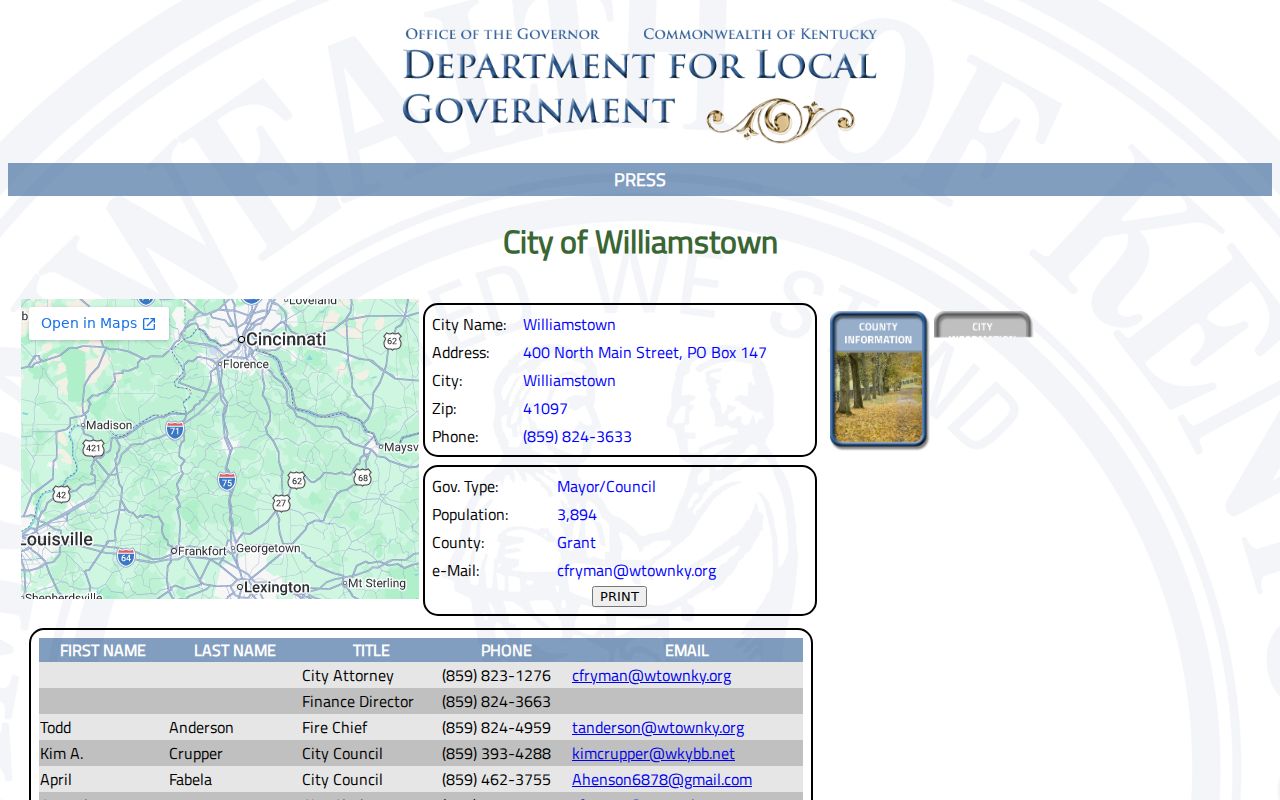
Its role is contact verification, not a searchable criminal-history database.
Williamstown Police Records
City records custodian
Williamstown, KY 41097
859-824-3353
Confirm hours and delivery method
Police Record or Sheriff Record?
The agency named on the citation or report controls the request. Williamstown Police holds its reports. The Grant County Sheriff holds sheriff incidents and arrests. Kentucky State Police holds trooper and highway records. A Williamstown mailing address does not prove city-police involvement, and the detention center cannot replace the arresting agency’s narrative.
| Clue | Likely first contact | Record |
|---|---|---|
| Williamstown officer or city report number | City records custodian | Incident or arrest report |
| Grant sheriff deputy | Grant County Sheriff | Sheriff report |
| KSP trooper or state route event | KSP open records | Trooper incident or crash record |
| Booking number | Grant detention center | Custody record |
When the agency is unknown, provide the date and exact place to the jail or dispatch channel and ask which department transported the person. Then direct the formal request to that department.
Booking and Arrest Records in Williamstown
Williamstown officers normally transport an arrested person to the Grant County Detention Center. Jail staff create a separate intake file with booking time, arresting agency, alleged charge, bond, custody status, fingerprints, photograph, property, and release data. That booking is not a conviction and may differ from charges later filed by a prosecutor.
For current custody, call the detention center at 859-824-5191. For a historic booking no longer shown online, ask the jail for the specific intake or release record. For the officer’s account, request the report from the arresting agency. For the result, contact the clerk. These channels may update at different speeds, so a fresh booking can appear before a court-history report.
Williamstown record path: police action › Barnes Road booking › District complaint › Circuit case if indicted › final disposition.
Booking Is Not Conviction
A booking charge records the allegation presented at intake. Prosecutors may amend, add, decline, or dismiss charges. A grand jury indictment is a formal accusation, not proof of guilt. Only the court file shows whether the matter ended in dismissal, acquittal, plea, trial judgment, or another disposition.
- Booking
- The jail’s record of custody and intake.
- Complaint
- A sworn allegation that begins a criminal court matter.
- Disposition
- The result entered for a charge, such as dismissal or conviction.
- Expungement
- Kentucky’s process for removing qualifying records after a court order.
Compare names, dates, case numbers, and charges before treating two records as the same event. For a full self-review, place the booking beside the clerk docket and any statewide AOC report.
The Williamstown Municipal Court File
Kentucky’s unified judiciary means Williamstown does not have a separate municipal court database. Grant District Court handles city ordinance matters, traffic cases, violations, misdemeanors, and the early stages of felony cases. An indicted felony proceeds in Grant Circuit Court. Both are served by the clerk at the Judicial Center.
| Court Name | Grant District Court and Grant Circuit Court |
|---|---|
| Case Types Heard | District: ordinance, traffic, violations, misdemeanors, felony preliminary matters; Circuit: indicted felonies |
| Case Lookup Channel | Clerk counter or phone; AOC FastCheck for statewide court reports |
| What the Docket Shows | Case number, charges, hearings, warrants, plea, disposition, sentence, and payment events where public |
| Copies & Fees | Request from the clerk; current copy and certification fees were not confirmed |
Ask for the docket first. It identifies the precise filing or order worth copying and avoids a broad, costly request.
Older Williamstown Case Files
Archived Kentucky case research needs a locator number. State Records Center staff cannot search an old file by name or Social Security number. Begin with the Grant clerk, provide the full name and approximate year, and ask for both case and locator numbers. Then contact the State Records Center using the channel supplied by Kentucky Court of Justice.
This two-stage route matters for older Williamstown criminal records. City police files and court archives follow different retention and storage paths. A missing online result does not establish that no file exists. It may mean the matter predates indexed coverage, is archived, is confidential, or was expunged.
The official KRS Chapter 431 source supplies current criminal-procedure and expungement text.
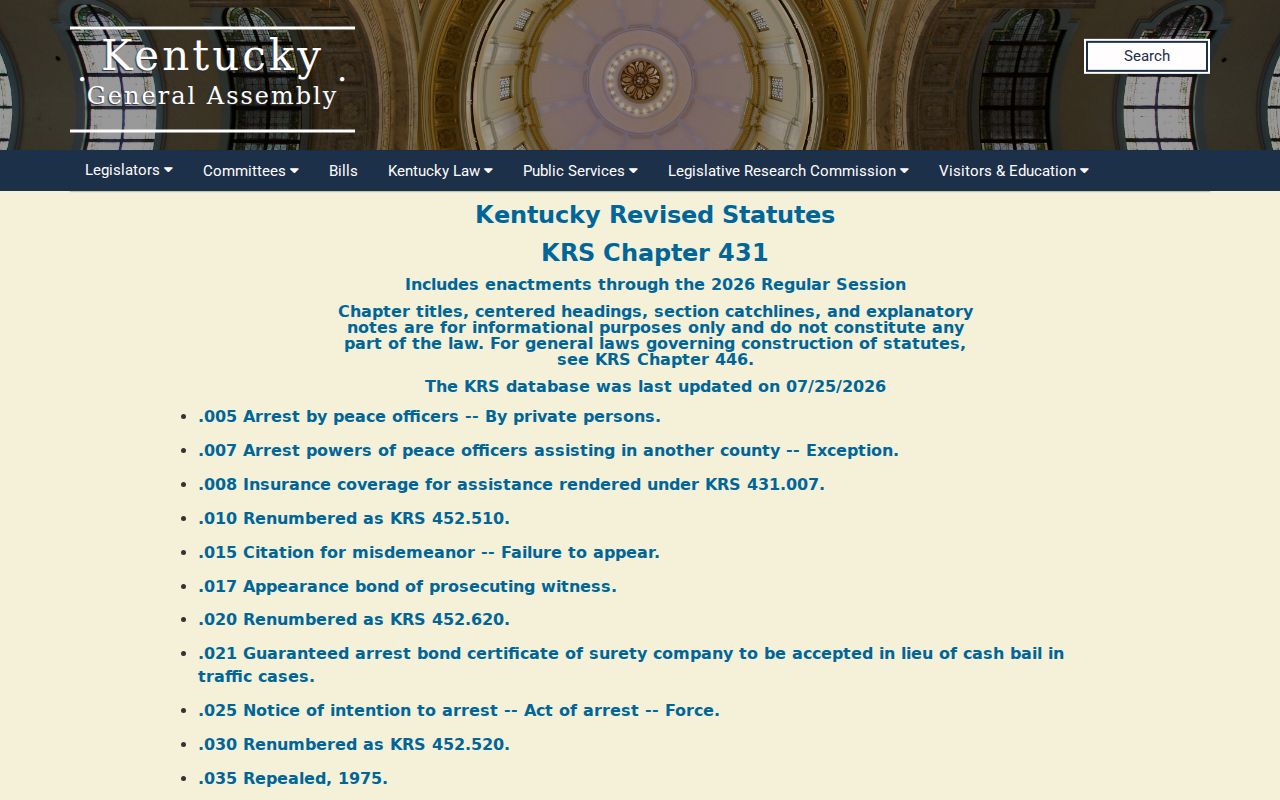
The statute source helps distinguish a court outcome from later relief that changes public access.
How Williamstown Records Reach the County
Williamstown Police documents the event. The detention center adds custody data. Grant District or Circuit Court records prosecution, while the Kentucky State Police Criminal Identification and Records Branch may receive fingerprint-linked arrest information. Court dispositions feed Kentucky’s unified court-history system and AOC reports.
Record flow: Williamstown Police › Grant County Courts › Kentucky State Police Criminal Identification and Records Branch
Use the newest local source for recent activity and the clerk for the authoritative case result. AOC FastCheck is a statewide Kentucky court report, not a full fingerprint rap sheet. It excludes federal and confidential case types. A fingerprint-supported KSP or FBI self-review may reveal identity-linked data and reporting gaps that a name search cannot settle.
Williamstown’s Kentucky Law Sources
Official statutory text changes over time. The Kentucky Revised Statutes database is the proper place to confirm the current version before relying on a section.

The database connects Williamstown access questions to the enacted statewide rules rather than an unofficial summary.
Procedure and public access overlap. Chapter 431 addresses arrest procedure and qualifying expungement, while Chapter 61 governs requests to public agencies. A court order may change access to a qualifying matter, but a dismissal alone does not always remove every record.
Williamstown Record Access Rules
The Kentucky Open Records Act applies to city police records, but it does not require release of every detail. Active investigations, juvenile information, protected victim data, medical information, personal identifiers, and material covered by a statutory law-enforcement exemption may be withheld or redacted. Agencies should respond under the Act’s process and identify the legal basis for a denial.
The official KRS Chapter 61 text is the source for the open-records framework.
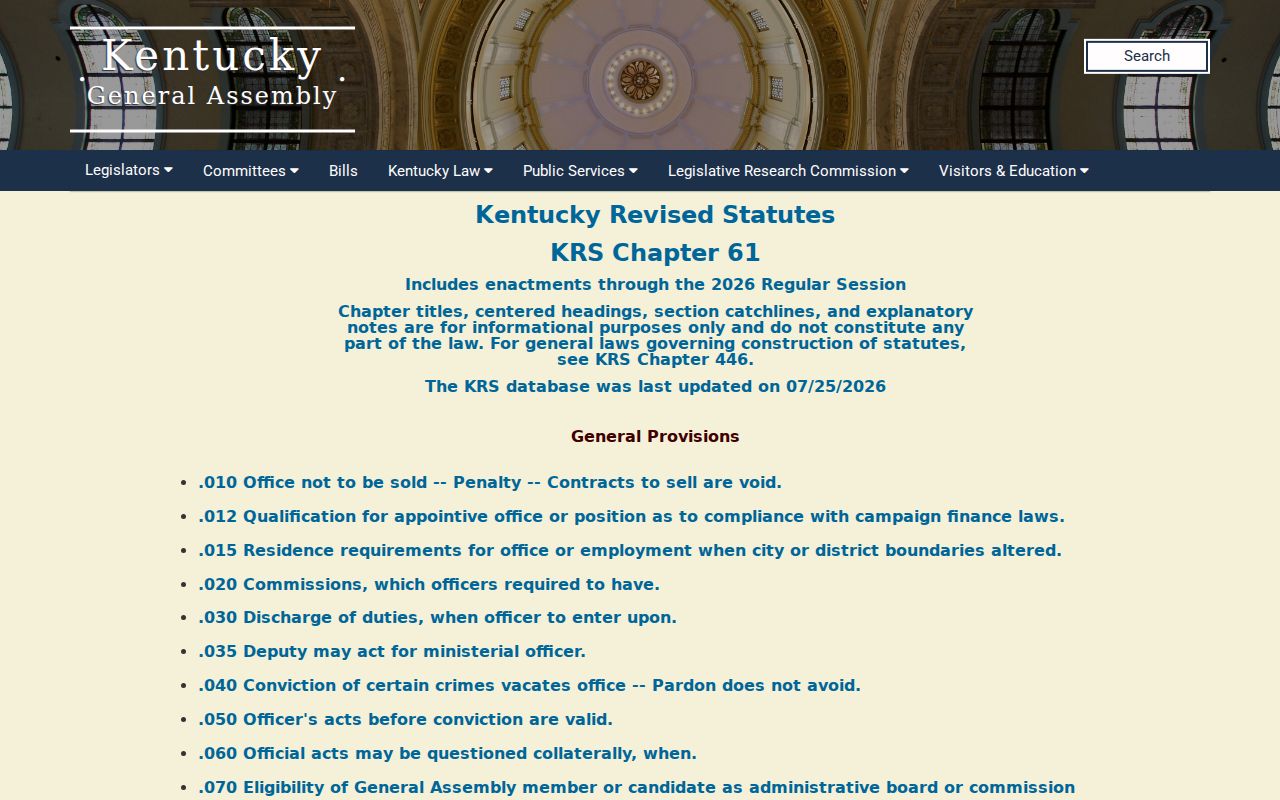
It supports a narrow request for identified records and nonexempt portions rather than a demand for an undefined background file.
Key Statutes:
Kentucky Open Records Act - KRS 61.870 through 61.884 establishes access, exemptions, agency response, and review.
KRS 17.150 - Investigative reports may be withheld while disclosure would harm a pending prosecution.
KRS 431.073 and 431.076 - These sections govern qualifying conviction and nonconviction expungement.
Correcting Williamstown Record Mismatches
First identify which source is wrong. A police narrative, jail booking, clerk docket, AOC report, and fingerprint history are maintained by different custodians. Take the case number, disposition, and certified order to the office reporting the error. If a qualifying matter was expunged, keep certified proof of the order and full payment when asking an official system to correct a stale entry.
A private report must be disputed with that reporting source. The clerk cannot directly edit every downstream database. For official self-review, compare the city report with the Grant court file and the relevant KSP or FBI identity-history channel. That sequence reveals whether the mismatch began at arrest, booking, court disposition, or later transmission.
Timing explains many apparent conflicts. The Barnes Road jail may publish a booking while the complaint is still being prepared. District Court may later show a different charge after prosecutor review. A felony can begin in District Court and move to Circuit Court after indictment, creating linked entries rather than one continuous public screen. AOC processing can lag behind the local docket. Match the arrest date, incident number, booking number, and court case number before asking for a correction. A difference in wording is not always an error; it may mark a later stage.
For an older Williamstown matter, begin with the clerk even when a police event started the trail. The clerk can locate the case and supply the docket, disposition, and archival locator number. Take those identifiers to the city custodian or jail if the source record must also be reviewed. When a public copy omits protected data, do not mistake a lawful redaction for a faulty file. Ask the custodian to explain the exemption and request the remaining nonexempt portion. If the court granted expungement, confirm that the order covers every charge at issue. Kentucky relief is case and charge specific, so an uncovered count may remain visible even when another count was cleared. AOC also sends the subject notice and a copy when another requester orders a statewide report and a record is found. That notice can supply a useful comparison point, but the Williamstown clerk still controls the local court file.